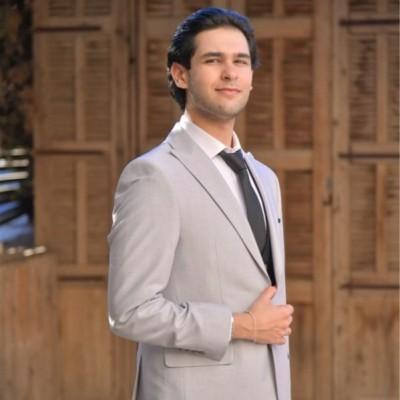
Elia Alghazal

Elia Alghazal

Software Engineer · AI Researcher · Co-Founder

Download CV

Work

CrashLens
End-to-end IoT and AI crash detection with emergency dispatch and insurance reporting
Python · Raspberry Pi 5 · Spring Boot · React Native
2025
SHARP-RAG
Self-correcting agentic RAG pipeline for multi-hop question answering
Python · LangGraph · ChromaDB · HuggingFace
2026
EmotionAI
Real-time facial emotion recognition using convolutional neural networks
Python · PyTorch · OpenCV
2025
Web Bluetooth Medical Dashboard
Browser-native BLE dashboard streaming live physiological data from medical devices
JavaScript · Web Bluetooth API · React
2025
DFA Minimization Visualizer
Interactive automata builder with step-by-step Hopcroft minimization for teaching
React · JavaScript
2024

Research


PREPRINT · ZENODO · JUNE 2026

SHARP-RAG: Self-Correcting Hierarchical Agentic Retrieval-Augmented Generation for Multi-Hop Question Answering

Elia Alghazal · Independent Researcher · Beirut, Lebanon

Multi-hop question answering requires chaining evidence across several documents, a setting in which naive RAG frequently fails because it retrieves once and never verifies whether the retrieved context supports an answer. SHARP-RAG addresses this with a four-agent LangGraph pipeline: a Planner, Retriever, Critic, and Synthesizer cooperate in a cyclic stateful graph where the Critic emits a structured JSON verdict that gates answer generation and drives targeted re-retrieval. Evaluated on 20 HotpotQA fullwiki questions, the work's central finding is that critique model calibration determines whether the self-correction loop helps or hurts, more than the architecture itself.

SystemEMF1Latency
Naive RAG25.0%29.5%18.0s
Planning Baseline25.0%28.1%24.8s
SHARP-RAG v215.0%15.8%57.2s

Core finding: critique model calibration, not architecture, determines whether self-correction helps or hurts performance.

Read PaperGitHub
IEEE · UNDER REVIEW · 2026

CrashLens: Smart Crash Detection and Emergency Response via IoT and Artificial Intelligence

E. Alghazal, G. Khayat, W. Ishak, B. Farhat, M. Allaw · Advised by Dr. C. Boustany, AUST

CrashLens is an edge AI pipeline for automatic vehicle crash detection and emergency dispatch. A Raspberry Pi 5 equipped with IMU, GPS, camera, and a 4G module performs sensor fusion and YOLO inference in real time at the edge. On crash detection, the device packages video, location, and sensor data and routes it via 4G to role-based dashboards for drivers, first responders, and insurance providers, with sub-30-second end-to-end latency. The system includes license plate extraction, an analytics pipeline, and companion mobile applications.

Paper link coming upon publicationLive Site

Experience


Co-Founder & Lead Engineer, KGH Solutions

Architected and deployed CrashLens, a production IoT and AI crash detection ecosystem routing evidence to insurance providers and emergency services with sub-30-second latency. Designed multi-agent AI architecture for enterprise consulting clients. Live at crashlens.org.

Backend Development Intern, SmartCode SAL

Built production Spring Boot REST APIs with DTO mapping and layered service architecture. Integrated SOAP third-party providers via custom JAXB mapping. Ran Apache JMeter load tests to 2,000 concurrent users with a 0.20% error rate over a two-hour endurance run.

B.S. Computer Science, AUST, Zahle, Lebanon

High Distinction. GPA 3.80 or above. Data Science Emphasis 4.00 out of 4.00. Distinguished List three semesters. Honor's List one semester. TOEFL iBT 99 out of 120. CCNA Switching, Routing and Wireless Essentials.

I build systems that have to work. Edge devices, AI pipelines, production backends. And I research why they sometimes don't.

I'm a software engineer and independent AI researcher from Zahle, Lebanon, with a B.S. in Computer Science from AUST (High Distinction, 2026). My work spans IoT hardware, agentic AI pipelines, and backend systems. I co-founded KGH Solutions, deployed CrashLens to production, and published independent research on self-correcting retrieval systems, all while finishing my degree. I'm looking for engineering roles where the problems have real stakes, or graduate programs where I can push further on agentic AI and retrieval systems. I care about depth over polish: understanding failure modes, not just shipping features.

Elia Alghazal

TOEFL iBT 99 / 120

English C2 · Arabic Native · French B2

2 papers · 5 deployed projects · 1 startup

Contact


Open to engineering roles, research collaborations, and graduate study discussions.